Short answer: Not automatically. A commercial license for a graphic tells you what the designer or marketplace will let you do with their file. It does not tell you whether the finished listing meets Etsy’s rules for what can be sold as “designed by a seller,” and it does not tell you whether you’ve cleared every copyright or trademark issue in the file. These are three separate questions, and a “yes” to one doesn’t mean “yes” to the others.
If you want to sell printable wall art on Etsy using purchased graphics, a commercial license is only one part of what you need to check.
Affiliate Disclosure: This post may contain affiliate links. If you make a purchase through one of these links, ArtistCastle may earn a commission at no additional cost to you.
- Commercial License vs. Etsy Eligibility: Why They're Different
- What Etsy Currently Requires for Digital Downloads
- Creative Fabrica: What Its License Does — and Doesn't — Mean for Etsy
- Creative Market
- Design Bundles
- Practical Printable Wall Art Examples
- Scenario A: Downloading a purchased floral illustration and selling essentially the same illustration as a printable
- Scenario B: Using licensed elements as components within a substantially new composition you created
- Scenario C: Selling the purchased graphics themselves, or files that let customers extract or reuse the original assets
- Scenario D: Combining purchased elements with typography, layout, or background elements, but making only superficial changes
- A Before-You-List Checklist
- FAQs
- Can I use Creative Fabrica graphics in Etsy printable wall art?
- Does a commercial license mean I can sell the design on Etsy?
- Can I sell Canva or stock graphics as Etsy digital downloads?
- Is adding text to a purchased graphic enough to make it sellable?
- Can I sell a flattened JPG or PDF if the source graphics were licensed?
- Sources & References
Commercial License vs. Etsy Eligibility: Why They’re Different
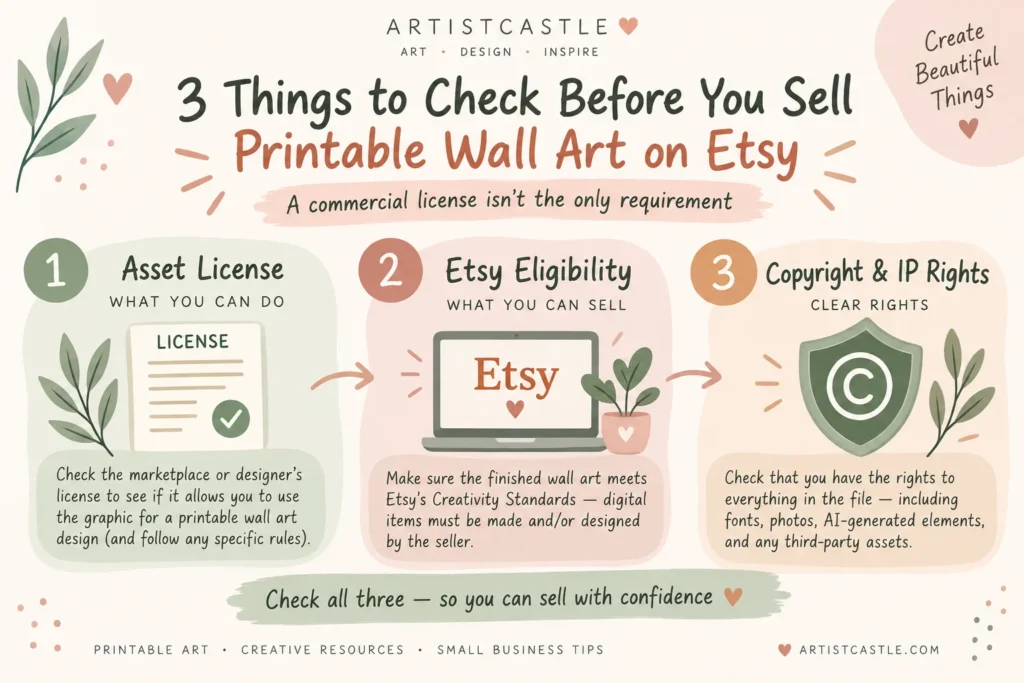
It’s easy to assume that once you’ve paid for a “commercial use” license, you’re cleared to sell whatever you make with it. In practice, three separate questions are involved, and each one can say no even when the others say yes:
- 1. Asset license — Does the marketplace or designer’s license actually permit what you want to do with this specific file? Licenses vary enormously between platforms, between license tiers on the same platform, and sometimes between individual products on the same site.
- 2. Etsy marketplace eligibility — Even with full legal permission to use a graphic, does the finished item meet Etsy’s Creativity Standards for what counts as a seller’s own design? Etsy has its own separate bar for what can be listed, independent of what any license allows.
- 3. Intellectual property rights — Do you (or the platform you bought from) actually hold clear rights to everything in the file — including any fonts, photos, AI-generated elements, or third-party assets combined into it?
A license can say “commercial use OK” while the finished product still fails Etsy’s originality requirement. Etsy can approve a listing while a licensing or copyright problem sits underneath it, unnoticed, until someone flags it. None of these three is a substitute for checking the other two.
What Etsy Currently Requires for Digital Downloads
Etsy’s Creativity Standards sort listings into categories, and digital downloads like printable wall art fall under “Designed by a seller.” According to Etsy, that category covers original content created by the seller and sold as a digital download — Etsy’s own example is “a digital file of a seller’s unique graphic design.”
Etsy is direct about what does not qualify: a bundle, collection, scan, or PDF of someone else’s work. That means a commercial asset license alone does not establish that the finished printable qualifies as your own seller-designed digital item under Etsy’s rules.
Etsy’s What Can I Sell on Etsy? help page adds that everything listed for sale must be made, designed, handpicked, or sourced by the seller, and that it’s the seller’s responsibility to make sure their shop complies with Etsy’s policies — Etsy doesn’t pre-vet this for you at the point of listing.
Nowhere in Etsy’s policy does it say that having a commercial license from a stock or craft marketplace automatically satisfies this “designed by a seller” standard. The license and the Etsy requirement are evaluated separately.
Creative Fabrica: What Its License Does — and Doesn’t — Mean for Etsy
Creative Fabrica’s current Subscription License draws a clear line between “Digital End Products” (like a printable wall art file you sell to multiple buyers) and physical products made through Print on Demand.
For digital end products, the license allows you to use elements — for example, floral graphics — to build a new design, but only if the result has distinctive new features and doesn’t compete with the original item you downloaded. The license gives a specific example: downloading a flower and creating a card with just that flower, without significant modification, is not allowed. The finished digital file also has to be flattened so buyers can’t extract the original graphic from it.
Separately, Creative Fabrica’s POD terms distinguish “Basic POD” (which requires your design to look vastly different from the original asset) from “Full POD” rights, which — for items downloaded under the current license — can permit selling a physical product without modification. That Full POD allowance is specifically about physical, print-on-demand items; it doesn’t loosen the separate rule for digital end products, which still needs to be a genuinely new, flattened design.
None of this changes whether Etsy will treat the finished wall art file as “designed by a seller.” That’s a separate check you still have to make yourself.
Creative Market
Creative Market’s licenses are structured around what they call “End Products.” Their Commercial License allows you to create End Products — including printable wall art — but with an important restriction that shows up across their help documentation: your customers cannot end up with access to the original, unmodified asset, since that would count as prohibited redistribution.
For uses that resemble on-demand or automated production, Creative Market’s own guidance is specific: the item you create has to be significantly different from the original graphic, require real time, effort, and skill to produce, and must not derive its primary value from the licensed graphic itself. A design that’s mostly the purchased illustration with the color changed or a border added is unlikely to meet that bar.
Creative Market’s Personal License is more restrictive again — it does not allow the licensed graphic to be used in any End Product for sale at all, commercial or otherwise. If you’re using a personal-tier download, selling anything made with it (on Etsy or anywhere else) isn’t permitted regardless of how much you transform it.

Design Bundles
Design Bundles’ membership tiers each carry different rights. The Personal License (Hobbyist plan) doesn’t cover commercial use or selling physical products at all. The Premium and Corporate licenses do cover selling physical end products, and a separate POD Add-On extends this to items made through print-on-demand services.
Design Bundles is explicit that neither the Premium nor Corporate license allows a design to be used as-is on any POD website. Their support documentation adds that licensed assets must be transformed significantly before being used in digital items for sale, per their own Transformative Guidelines, and that products can’t be uploaded to POD platforms as standalone designs or templates — they have to be part of a finished, unique physical product.
For a printable wall art digital download specifically, this means checking two things: whether your plan’s license covers digital items for sale at all (not just physical products), and whether your finished design meets Design Bundles’ own bar for “significantly transformed,” which is a similar test to the ones above, not an automatic pass just because you hold a commercial-tier membership.
Practical Printable Wall Art Examples
These scenarios aren’t legal rulings — they’re a way to walk through the three questions (license, Etsy, IP) for situations that come up often. Always check the exact license for your specific asset and platform; the general patterns below can point you in the right direction, but they can’t replace that check.
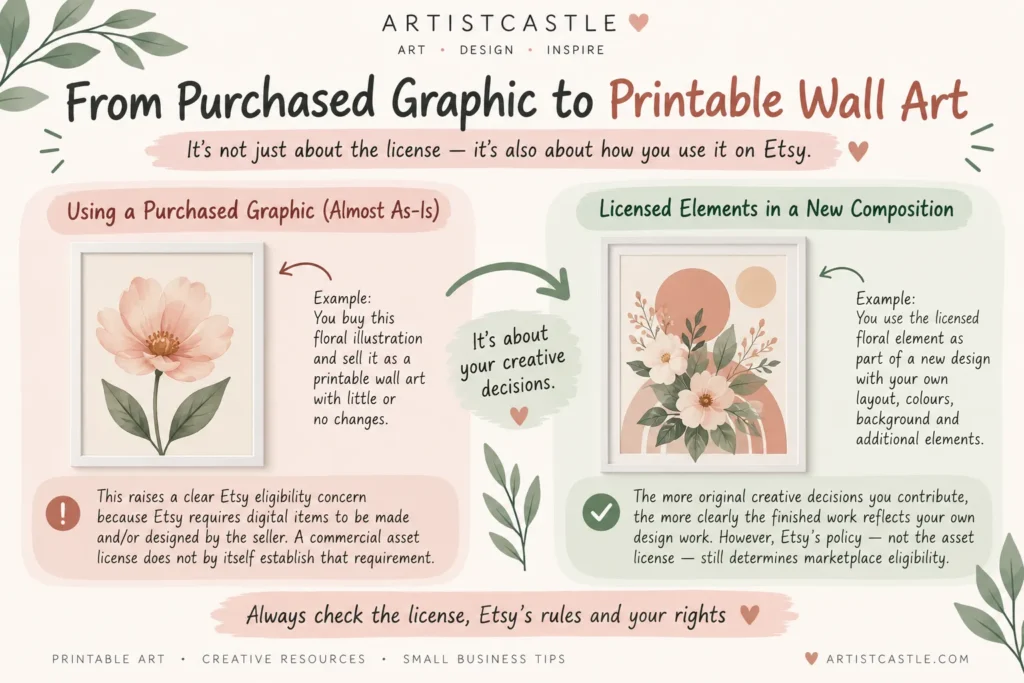
Scenario A: Downloading a purchased floral illustration and selling essentially the same illustration as a printable
License question: Most of the licenses above specifically prohibit this. Creative Fabrica’s digital end product terms give almost this exact example as prohibited; Creative Market requires a design that’s significantly different from the original before it counts as a sellable End Product, and Design Bundles requires the result to meet its own Transformative Guidelines.
Etsy question: This raises a clear Etsy eligibility concern because Etsy requires digital items to be made and/or designed by the seller. A commercial asset license does not by itself establish that requirement.
What to verify: Whether the specific license you hold allows the graphic to be sold with essentially no changes as a standalone digital product. For most subscription and marketplace licenses, it doesn’t.
Scenario B: Using licensed elements as components within a substantially new composition you created
License question: This is the type of use most “digital end product” licenses are actually built for — combining licensed elements with your own layout, additional design work, and typography to create something new, flattened so the source elements can’t be pulled back out.
Etsy question: The more original creative decisions you contribute, the more clearly the finished work reflects your own design work. However, Etsy’s policy—not the asset license—still determines marketplace eligibility.
What to verify: That the specific asset category (some platforms treat patterns, fonts, and graphics differently) is covered for this use under your license tier, and that your file is flattened where the license requires it.
Scenario C: Selling the purchased graphics themselves, or files that let customers extract or reuse the original assets
License question: This is prohibited under every license reviewed here. Creative Fabrica requires digital end products to be flattened specifically to prevent extraction; Creative Market treats this as redistribution, which none of its licenses permit; Design Bundles states plainly that original files can’t be shared, sublicensed, or resold.
Etsy question: This also fails Etsy’s standard, since it’s someone else’s work being resold rather than something you designed.
What to verify: Never sell layered source files, editable templates that expose the original licensed graphic, or “digital paper” style packs that are really just resold stock, unless a license explicitly grants redistribution rights (which is rare and usually requires a separate, specific purchase).
Scenario D: Combining purchased elements with typography, layout, or background elements, but making only superficial changes
License question: This is the trickiest gray area. Each license above sets its own bar here, but none treats a token change as sufficient — Creative Fabrica’s own example calls out changing a template’s colors and reselling it as a “new” product as prohibited; Design Bundles requires following its own Transformative Guidelines rather than making token changes.
Etsy question: A design that’s mostly the purchased graphic with a font layered on top may not read as genuinely “designed by” you either, even if it clears the license.
What to verify: Compare your finished design honestly against the source graphic. If a buyer is essentially getting the stock graphic with minor cosmetic changes, it likely doesn’t meet either the license’s transformation requirement or Etsy’s originality standard — this is worth erring on the side of caution about.

A Before-You-List Checklist
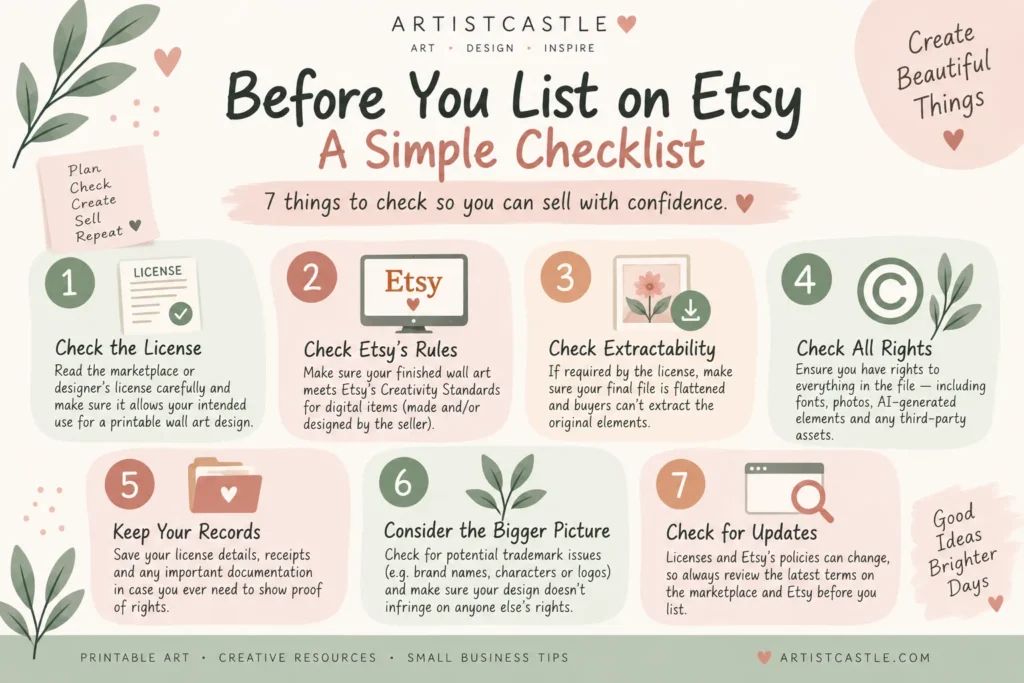
- Confirm the exact license type for this specific asset — not just “what the platform generally offers,” since tiers and even individual products can differ.
- Check whether that license covers digital end products for sale, not only physical POD items — these are often governed by different terms.
- If your license requires flattening or requires the original element to be non-extractable, confirm your finished file actually meets that.
- Compare your finished design against the source graphic — would you call it genuinely transformed, using the platform’s own guidance as the test?
- Separately ask the Etsy question: is this something I designed, or something I’m reselling with light changes?
- Confirm you hold clear rights to every element in the file — fonts, photos, AI-generated pieces, and any Canva or stock content included.
- Keep your license receipts and documentation on file in case a question ever comes up.
- Recheck both the asset’s license terms and Etsy’s current Creativity Standards periodically — both can and do change.
FAQs
Can I use Creative Fabrica graphics in Etsy printable wall art?
It depends on which Creative Fabrica license you hold and how much you transform the graphic. Their digital end product terms require the result to have distinctive new features and to be flattened. Separately, Etsy still requires the finished listing to be your own design, not a lightly modified purchased graphic.
Does a commercial license mean I can sell the design on Etsy?
Not by itself. A commercial license is the answer to only one of three separate questions — the asset license. It doesn’t automatically confirm Etsy marketplace eligibility or that every element’s copyright is cleared. Check all three.
Can I sell Canva or stock graphics as Etsy digital downloads?
Canva’s rules depend on the type of Content and how it is used. Canva prohibits distributing its Content on a standalone basis and places additional restrictions on certain on-demand uses. Check the current Content License Agreement for the specific Canva content in your design, then separately check Etsy’s seller-design requirements. For other stock sites, check that platform’s own license — terms vary widely, and this article can’t confirm terms for platforms not covered above.
Is adding text to a purchased graphic enough to make it sellable?
Generally, no — though each platform draws its own line. Creative Fabrica, Creative Market, and Design Bundles each treat a minor change like adding text or shifting a color as insufficient under their own respective transformation requirements. Etsy’s “designed by a seller” standard is looking for the same thing: genuine, seller-driven creative work.
Can I sell a flattened JPG or PDF if the source graphics were licensed?
Flattening addresses one specific requirement — stopping buyers from extracting the original elements — but it doesn’t by itself satisfy a license’s transformation requirement, and it doesn’t confirm Etsy eligibility either. Check both separately; flattening alone isn’t a complete answer.
Sources & References
- Etsy’s Creativity Standards
- Etsy Help: What Can I Sell on Etsy?
- Creative Fabrica: Subscription License
- Creative Market: Commercial License FAQ
- Creative Market: Graphics – Use in End Products for Sale
- Design Bundles: Our Licenses
- Canva: Content License Agreement
Licensing terms and marketplace policies change over time. This article reflects the official terms in effect at the time of writing — always check the current license for your specific asset and Etsy’s current policies before listing.
For more on choosing a design resource platform in the first place, see our 7 Best Websites for Design Resources review, and if you’re new to digital paper licensing basics, our guide on what digital paper is and how to use it covers personal vs. commercial licenses in more depth.