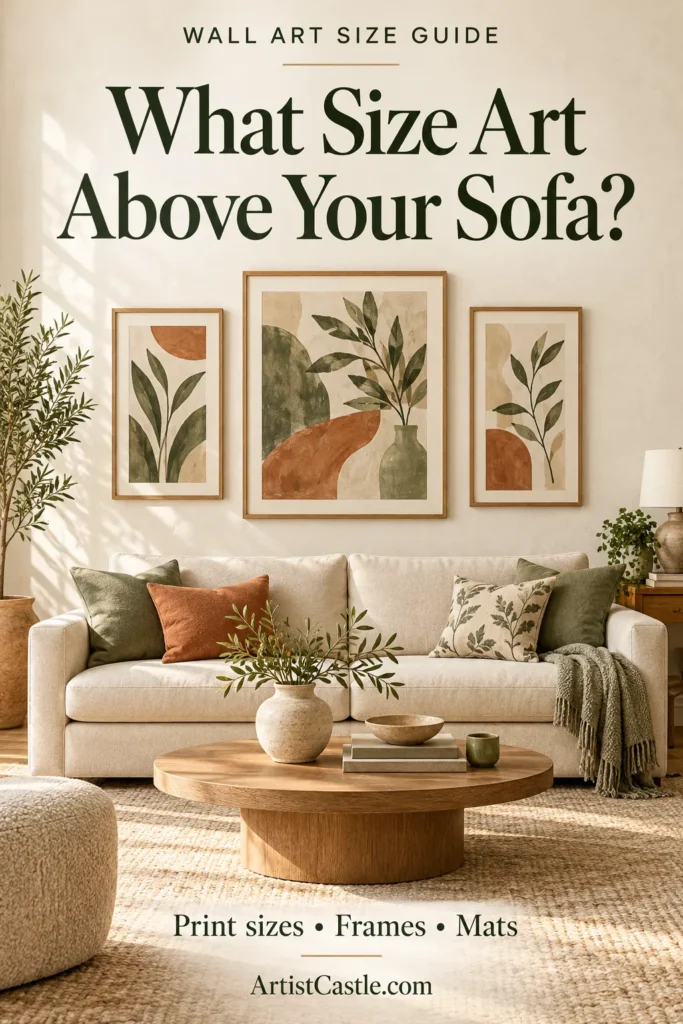
Short answer: Above a sofa, bed, or console, a good starting point is art that spans about two-thirds to three-quarters of the furniture’s width. Measure that width and check the finished outside size of any frame you’re considering. If you’re hanging more than one piece, add the gaps. Then tape up paper templates before you order anything.
That’s the whole method. The rest of this guide covers the parts that trip people up: why a print size and a frame size aren’t the same thing, how three sofa sizes work out with the sums shown, and what to check before you buy. Sizes are in inches first, with centimetres alongside (rounded to one decimal place).
Start with a tape measure
Gather a few numbers before you look at a single print.
- Measure the furniture. For a sofa, measure from the outer edge of one arm to the other. For a bed, measure the headboard itself (more on that below).
- Look at the wall around it. Windows, lamps, shelves, trim, and tall plants all shrink the space you can use. It helps to map these first and let the leftover space guide size and orientation.
- Sketch a few arrangements. One large piece, a pair, a row of three, a small grid. Different shapes can cover the same width and feel completely different.
- Find the finished outside dimensions of the frames you’re considering. That’s the number that matters on your wall.
- Add up the gaps if you’re hanging more than one piece.
- Test with paper. There’s a checklist near the end.

How wide should the art be?
Art above furniture often works at about two-thirds to three-quarters of the furniture’s width, and open wall space gets a similar proportion. These are flexible decorating guidelines, not fixed requirements. Treat them as a place to start looking, not a verdict.
For a group, apply the proportion to the whole arrangement. Measure from the left edge of the first frame to the right edge of the last, gaps included.
Plenty of good reasons can pull you away from that starting point. A narrow wall, a window beside the sofa, a very tall piece, or a heavy frame all change the picture. Wide mats and chunky frames also give art more visual weight. Your own taste counts too.
Centre over the furniture, not automatically on the wall. If a sofa sits to one side of a long wall, art centred on the wall would drift away from it. Centring on the sofa usually keeps the two reading as one group.
Empty walls are different. Filling 60 to 75 percent of an empty wall’s width is one suggestion. But a wall with a door at one end has a smaller usable section than its measurement suggests. Decide which stretch you’re actually filling. Portrait pieces suit narrow areas, and a pair, triptych, or gallery arrangement suits wide ones.
Print, paper, mat, and frame: five different measurements
A single listing can mention several sizes at once, and they aren’t interchangeable.
- Image size is the printed artwork area.
- Paper size is the full sheet, including any unprinted margin. A print with a white border has an image smaller than its paper.
- Mat opening is the visible window over the artwork.
- Stated frame size is the number in the product title. It usually describes the artwork the frame can accommodate, not the whole frame. But listing conventions vary, and some sellers list framed sizes that include the frame itself.
- Outside frame dimensions are the finished footprint on your wall.
A window mat sits on top of the paper and covers a sliver of each edge. One custom-frame seller sets the opening ¼ inch smaller than the paper on each side by default, and only 1/16 inch for photos it prints. The amount varies, so check what your framer or listing uses.
That overlap means the mat opening may conceal details near the paper’s edge. If your artwork has a border, a signature, or something close to the edge, ask about a custom opening. A wider mat or a larger frame also increases the finished wall footprint, even though the print itself stays the same size.
The frame has to accommodate the full paper sheet: its inner dimensions must be large enough to hold it, as the same seller notes. A mat covers the edges, but it can’t make oversized paper fit a smaller frame.
You may be tempted to add print, mat, and moulding widths yourself. Moulding profiles, mat borders, and how far a frame’s lip overlaps the mat all vary, so a quick sum can miss. Use the seller’s listed outside dimensions. If a listing doesn’t give them, ask.

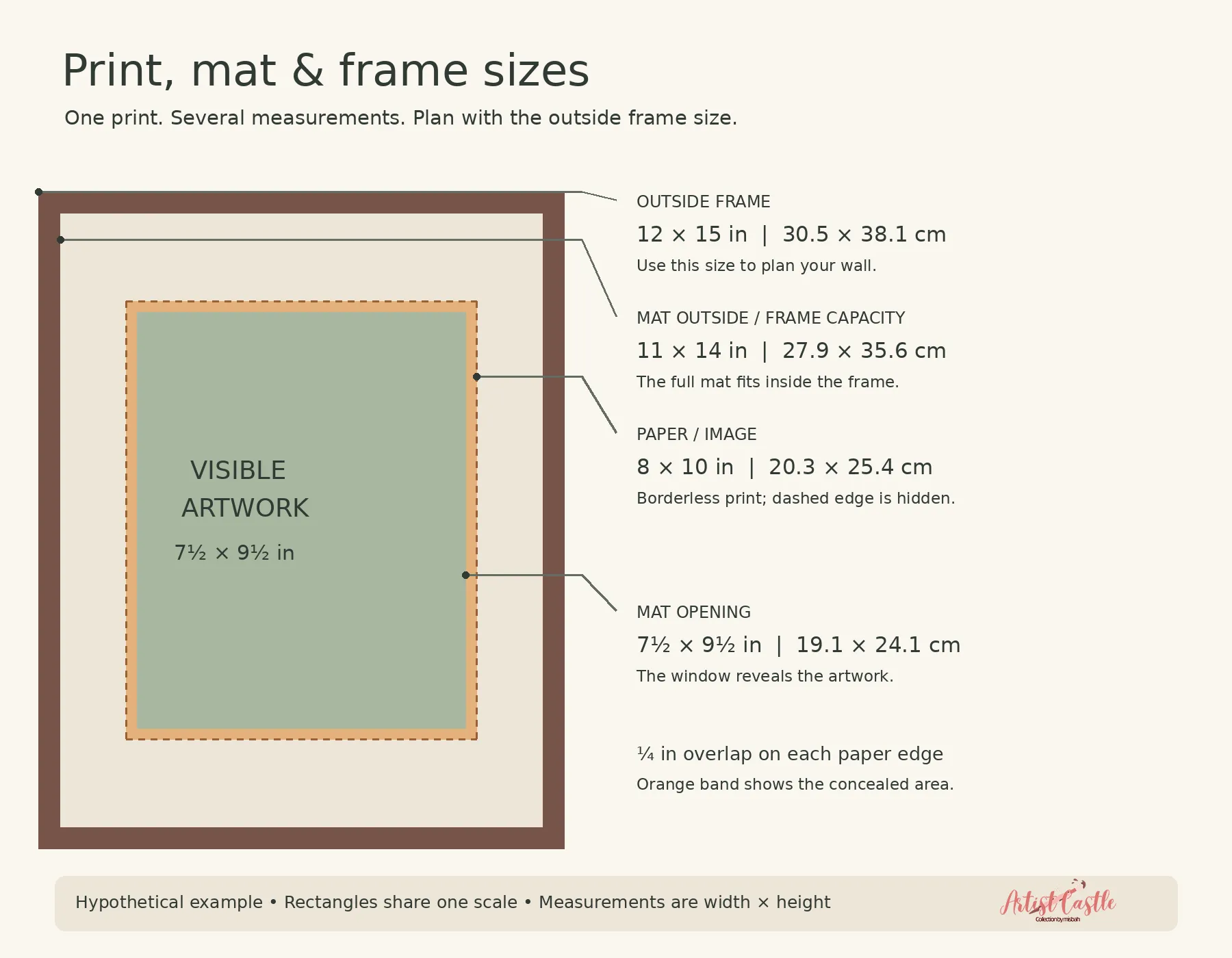
Hypothetical example (not a product specification):
- Paper: borderless 8×10 inches (20.3×25.4 cm)
- Mat opening: 7½×9½ inches (about 19.1×24.1 cm), so the mat covers ¼ inch of paper on every side
- Mat outside size: 11×14 inches (27.9×35.6 cm)
- The frame holds that 11×14-inch mat
- Seller-listed outside frame dimensions: 12×15 inches (30.5×38.1 cm)
The wall-planning measurement here is 12×15 inches, not 8×10 and not 11×14. Another frame holding the same mat could list different outside dimensions.
Three sofa examples
These examples assume sofas measured arm to arm. Every artwork measurement below is a hypothetical finished outside dimension, written width × height. They aren’t claims that these are standard print or frame sizes.
Each example includes a height check. The assumptions are illustrative and shared, so swap in your own numbers:
- Sofa back: 34 inches (86.4 cm) from the floor
- Gap above the sofa: 8 inches (20.3 cm)
- Ceiling: 96 inches (243.8 cm)
The top of an arrangement is the sofa-back height plus the gap plus the arrangement’s height. Guides suggest anything from 8 to 10 inches to 6 to 12 inches above a sofa back, so 8 inches is an example, not a requirement.
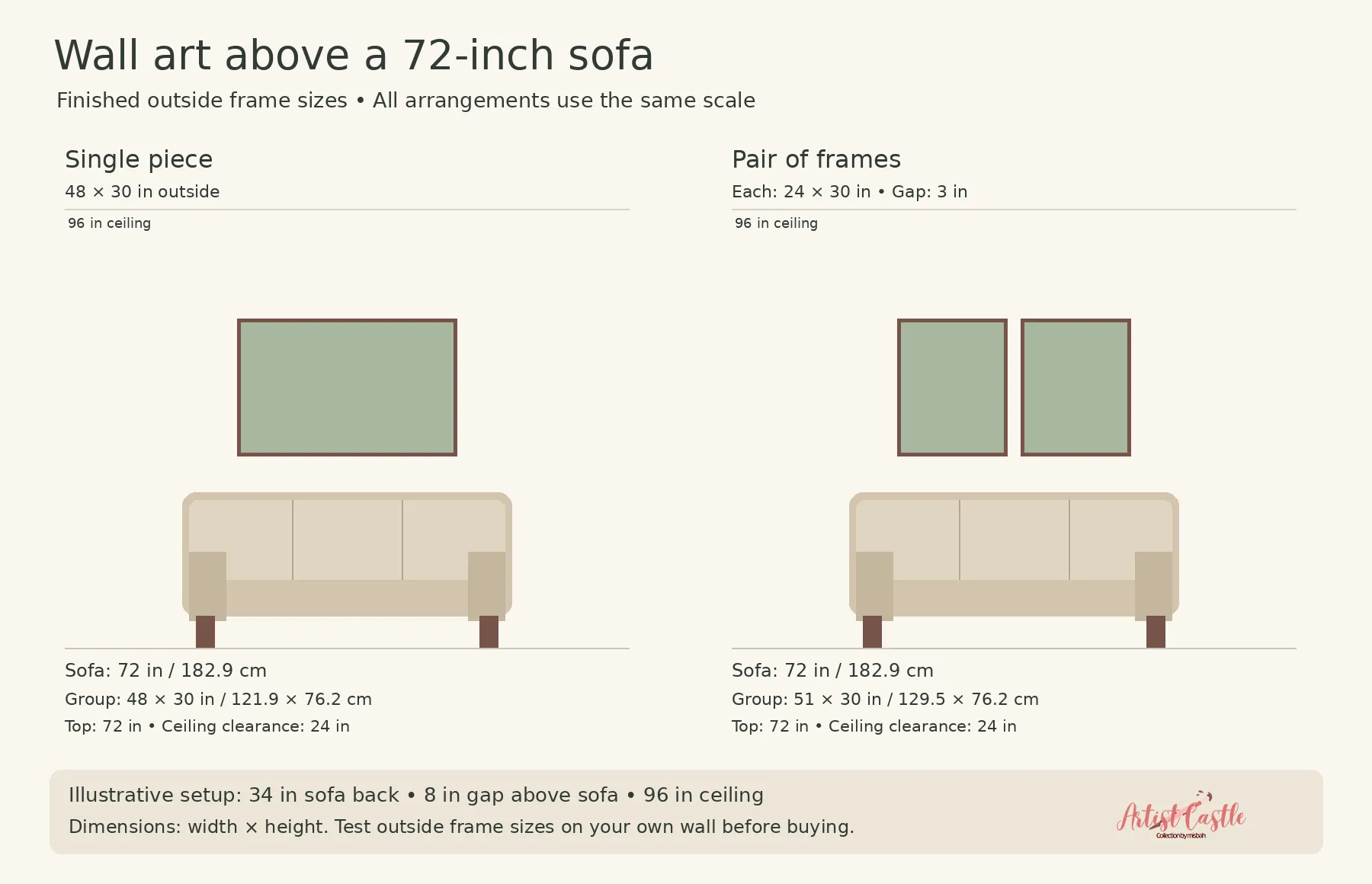
72-inch sofa (182.9 cm)
Two-thirds to three-quarters works out to roughly 48 to 54 inches.
- One piece, 48×30 inches (121.9×76.2 cm), is two-thirds of the sofa’s width.
- A pair of 24×30-inch frames (61.0×76.2 cm each) with a 3-inch gap (7.6 cm) gives 24 + 3 + 24 = 51 inches (129.5 cm), about 71%.
- Height check (either option): 34 + 8 + 30 = 72 inches (182.9 cm), leaving 24 inches (61.0 cm) to the ceiling.
84-inch sofa (213.4 cm)
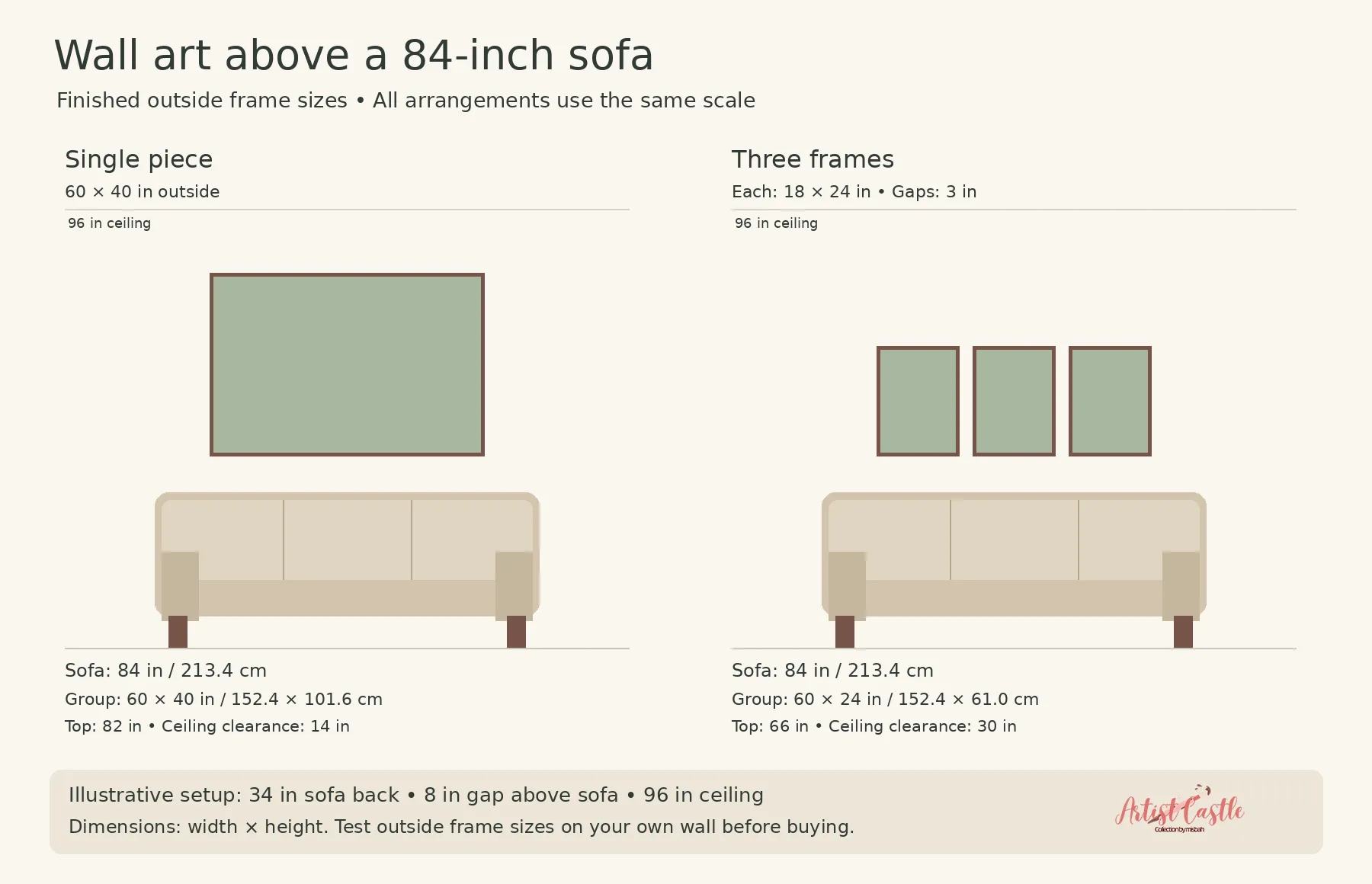
The starting point works out to roughly 56 to 63 inches.
- One piece, 60×40 inches (152.4×101.6 cm).
- Or three 18×24-inch frames (45.7×61.0 cm each) with two 3-inch gaps: 18 + 3 + 18 + 3 + 18 = 60 inches (152.4 cm).
- Both are about 71% of the sofa’s width, leaving 12 inches (30.5 cm) on each side. But equal width doesn’t mean equal effect. The single piece stands 16 inches (40.6 cm) taller than the trio, and the trio breaks the mass into three smaller shapes.
- Height check, single piece: 34 + 8 + 40 = 82 inches (208.3 cm), leaving 14 inches (35.6 cm).
- Height check, trio: 34 + 8 + 24 = 66 inches (167.6 cm), leaving 30 inches (76.2 cm).
The 60×40 piece leaves only 14 inches under a 96-inch ceiling, and ceiling trim takes some of that.
96-inch sofa (243.8 cm)
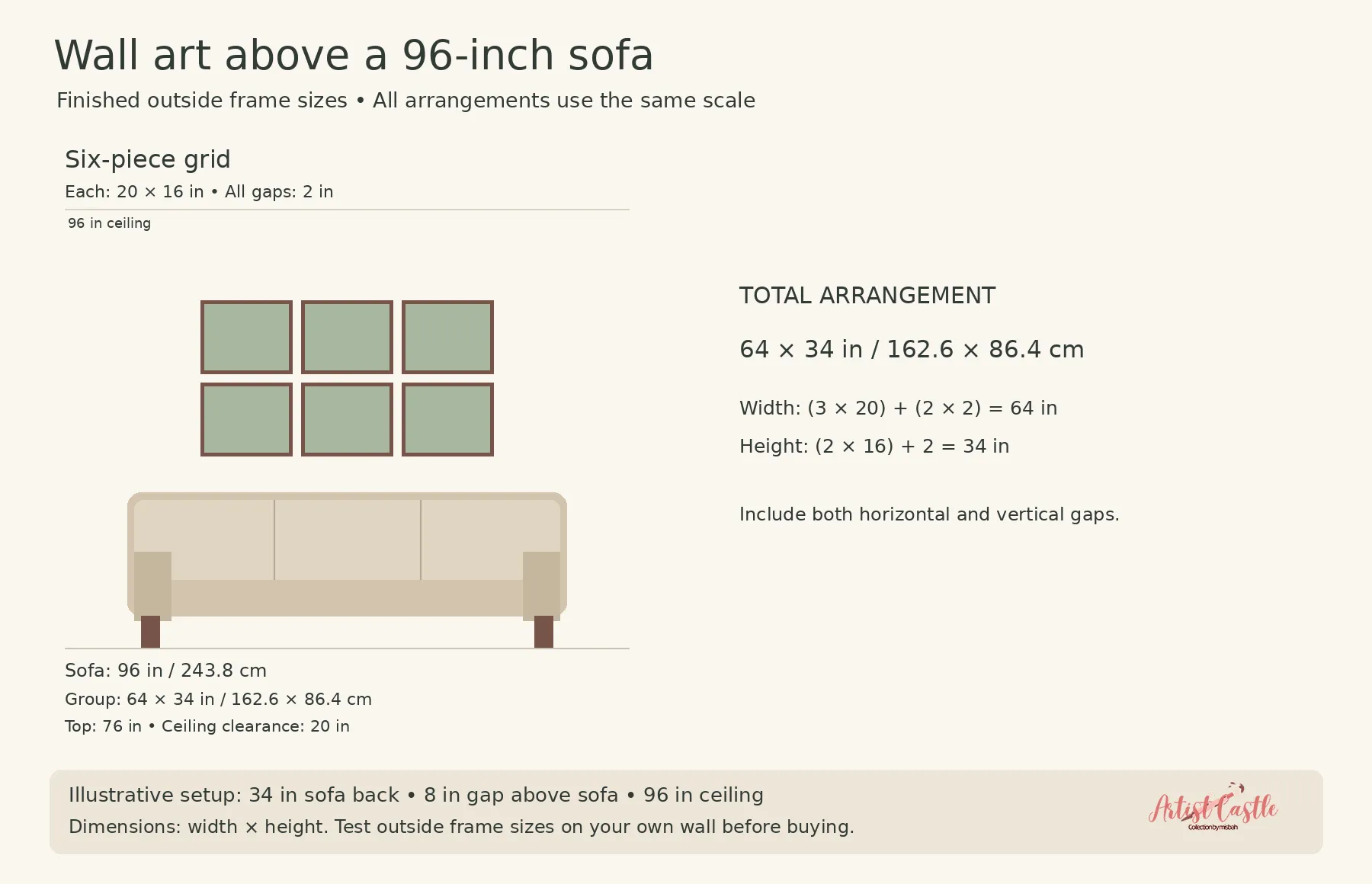
The starting point works out to roughly 64 to 72 inches.
- Six frames in two rows of three, each 20×16 inches (50.8×40.6 cm), with 2-inch (5.1 cm) gaps both ways.
- Width: 20 + 2 + 20 + 2 + 20 = 64 inches (162.6 cm), about two-thirds of the sofa.
- Height: 16 + 2 + 16 = 34 inches (86.4 cm).
- A 96-inch sofa isn’t necessarily a sectional. If you do have one, measure the section that sits against the wall.
- Height check: 34 + 8 + 34 = 76 inches (193.0 cm), leaving 20 inches (50.8 cm).
Real rooms need their own measurements, including ceiling trim.
Common print sizes
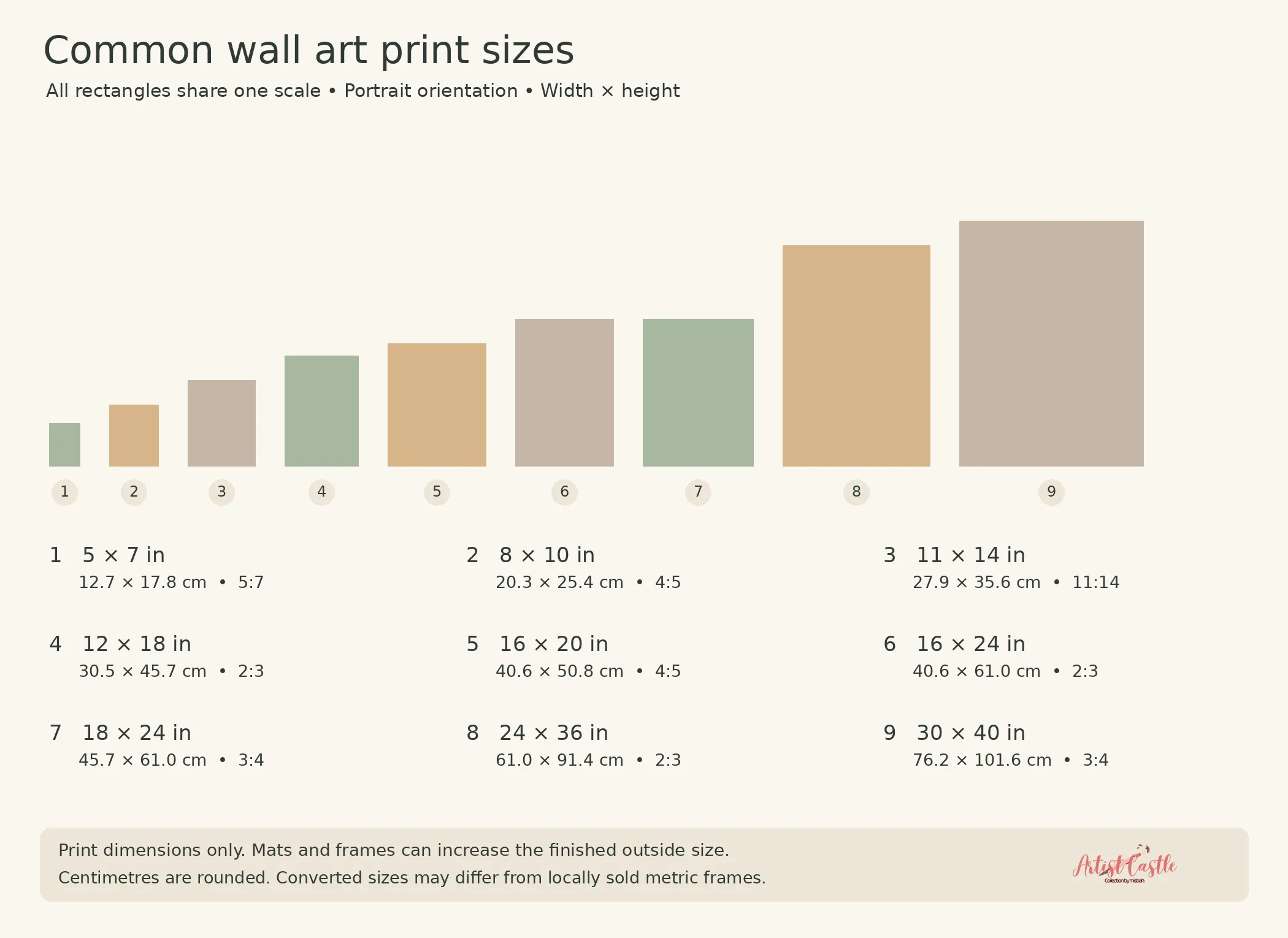
| Print size (in) | Approx. cm | Ratio (W:H, portrait) |
|---|---|---|
| 5×7 | 12.7×17.8 | 5:7 |
| 8×10 | 20.3×25.4 | 4:5 |
| 11×14 | 27.9×35.6 | 11:14 |
| 12×18 | 30.5×45.7 | 2:3 |
| 16×20 | 40.6×50.8 | 4:5 |
| 16×24 | 40.6×61.0 | 2:3 |
| 18×24 | 45.7×61.0 | 3:4 |
| 24×36 | 61.0×91.4 | 2:3 |
| 30×40 | 76.2×101.6 | 3:4 |
These are print dimensions, not outside framed dimensions. A mat and frame can increase the finished outside dimensions. Sizes are written width × height in portrait orientation, so a landscape print reverses the pair: a 24×36 portrait is 36×24 landscape.
Converted inch sizes don’t necessarily match frames sold locally in metric countries. Many of them sell in different standard sizes. The ISO A-series (A4 is 210×297 mm, A3 is 297×420 mm, A2 is 420×594 mm) is a separate system. Its sizes follow an approximately 1:√2 ratio, and the standard whole-millimetre dimensions involve rounding. Always check the frame’s listing.
Ratios, cropping, and print quality
Sizes that share a ratio can be resized proportionally without cropping. An 8×10 and a 16×20 are both 4:5, and a 12×18 and a 24×36 are both 2:3. That’s about shape only. Whether the file has enough pixels for the larger size is a separate question, and it affects print quality.
Different ratios take more thought. An 8×10 image won’t fill a 2:3 frame. You’d crop it, add borders, or rethink the layout. Stretching it to fit distorts the artwork.
A suitable mat is the easier fix for a differently shaped frame. It lets a print sit in a frame with different proportions, with the borders absorbing the difference. But the complete paper sheet still has to fit inside the frame, so a mat can’t make oversized paper fit a smaller one. Unequal borders can be intentional, too, and some framers make the bottom border a little wider. A mat doesn’t enlarge the printed image or add detail.
Pixels are a separate check. Pixel count affects how sharp a print looks, but the quality of the source image, the paper, and the printing process matter too. Changing the metadata alone does not create new image detail. As a simple example, an 8×10 print at 300 pixels per inch needs a file of 2,400×3,000 pixels. Print that same file at 16×20 and it spreads to 150 pixels per inch, which may look softer. Not every printable can be enlarged to every size in its ratio, so check which sizes the download supports and what your printer or print shop requires.

If you’re printing at home, our guide to the Best Paper for Printable Wall Art covers paper types and printing an 8×10 on US Letter.
Beds, consoles, hallways, and hanging height
Above a bed. Measure the headboard, not the mattress or the “queen” or “king” label. Headboards are typically the same width as the mattress or 2 to 4 inches wider, and extra-wide styles can run 25 to 30 inches wider. Leaving about 3 to 8 inches above a headboard is one suggestion.
Above a console. Think about the console’s width and any lamps or objects beside it. That same guide notes art can also lean on a console instead of hanging.
Hallways and small spaces. Check the usable wall and where people will actually stand. The guide suggests a gallery arrangement for a long, narrow hall and a single large piece for a wider one.
Hanging height. A common starting point on an open wall is about 57 inches from the floor to the artwork’s centre. Above furniture, placement tends to follow the furniture. In the sofa examples, an 8-inch gap puts the centres of the arrangements between about 54 and 62 inches. For a group, think of the whole arrangement as one shape. Use hardware rated for your wall and the artwork’s weight, and follow the manufacturer’s instructions.
Check it with paper templates before you buy
Retailers suggest testing layouts with paper or painter’s tape.
- Cut paper to each frame’s outside dimensions.
- Include every gap between frames.
- Use tape suited to your wall finish, and test it in a hidden spot first.
- Look from the doorway, from the sofa, and while standing.
- Check the height, nearby objects, and headroom.
- Photograph or note the final layout.
- Before ordering, confirm paper size, mat opening, frame capacity, and outside dimensions.

Common mistakes and quick answers
Most sizing regrets come from a short list: measuring only the print, forgetting the gaps, picking a frame from a rounded centimetre conversion, assuming two similar ratios are the same, enlarging a file past its supported size, and buying before testing the arrangement. Each is easy to avoid with the steps above.
Is a 24×36-inch print large enough above a sofa?
It depends on the finished size. A landscape 24×36 print is 36 inches wide, which is half of a 72-inch sofa’s width. A mat and frame can increase the finished outside dimensions, so check them. A pair or a larger size may suit your wall better.
How much space should I leave between frames?
2 to 3 inches is one common starting point, and about 3 inches is another. Keeping the gaps consistent matters more than the exact number.
Should I choose the print or the frame first?
Either works if you check both. Start with the art if the image matters most. Start with the frame if you already own frames or have a fixed space. Then confirm that paper size, mat opening, frame capacity, and outside dimensions all agree.
Can I print an 8×10 file at 16×20 inches?
The shapes match, since both are 4:5. Whether it looks good depends on the file’s pixels, the quality of the source image, and the printer’s requirements. Check the listing for supported sizes, or ask the seller.